
18세기 프랑스 유물론자인 라 메트리(La Mettrie)는 데카르트(René Descartes)의 ‘동물 기계론’을 인간에게 적용한 저서 <인간 기계론•인간 식물론, 1747>을 발표하였다. 21세기 대한민국의 양숙현은 인공지능의 상상력은 허락되는가?라는 질문에서 시작하여 인간-듣기의 사변적 가설 <인간 물질론과 합성의 존재도>를 발표한다.
인간 물질론이란?
인간 물질론의 역사는 인류 초기부터 시작됩니다. 기원전 제작된 천문학 도구인 안티키테라(AntiKythera Mechanism)의 활용을 시작으로 고대 그리스 철학자 데모크리토스는 인간을 물질적인 원자들의 집합체로 이해했으며 데카르트 역시 인간의 물질적인 측면을 중시하는 입장을 취하였습니다. 19세기 후반부터는 생물학적인 발전과 뇌과학적 연구가 이루어지면서, 인간의 심리적인 측면을 설명하는 것보다는 인간의 체질적 측면을 중시하는 입장이 강조되었습니다. 몇 가지 비판적 지점도 있지만 전반적으로 인간 물질론은 인간이 본질적으로 주변의 물질세계에 내재하여 있고 이에 영향을 받는다는 것을 이해하는 데에 대한 프레임워크를 제공합니다. 인간 물질론은 거대한 물질의 세계 내에 존재하는 인간 역시 물질로 해석하는 입장을 취합니다. 존재를 태양과 지구와 달의 주기 변화에 따른 물질 에너지의 발현으로 정의하며 오랜 기간 동양에서 기록된 태양과 달의 천문학 데이터를 바탕으로 얻어진 60개의 주기율표를 활용합니다. 이를 활용하여 존재에 물질성을 부여하고 그 에너지의 흐름을 따라갑니다. 흔히 존재하지 않는 것을 상상할 순 있지만 상상할 수 없다고 하여 존재할 수 없는 것은 아닙니다. 인간 물질론은 존재하지 않는 존재에 대한 상상을 위해 인공지능을 활용하여 본 이론의 시각적 모형을 통해 존재도를 구축합니다.
** 인간 물질론에 대한 정의는 2023년04월 09일과 2024년02월 13일 OPEN AI의 챗 GPT가 만들어낸 글을 작가가 수정하고 재구성한 글입니다.
합성의 존재도란?
합성의 존재도는 합성의 존재론과 관련된 용어이지만 대규모 언어 모델과 같이 순수하게 기계 생성 방법을 사용하여 지식 모델을 생성하는 예술적, 미학적 측면에 더 중점을 둡니다. 합성의 존재론은 기존 존재론이나 데이터 소스에 의해 제한되지 않는 개념과 관계의 새롭고 표현적인 표현을 생성하는 가능성을 탐구합니다. 합성의 존재도는 현실을 이해하고 인식하는 기존 방식에 도전하는 예술 작품의 창작을 가능하게 하며 관객이 합성 물질의 숨겨진 의미와 창발적인 의미에 참여하도록 유도할 수 있습니다. 합성의 존재도를 모델로 하는 가설은 완전히 탐구되거나 테스트 되지 않은 것이지만 예술, 철학, 문화 등 다양한 영역에 영향을 미칠 수 있습니다.
** 합성의 존재도에 대한 정의는 2024년01월 18일 마이크로소프트사가 edge 브라우저에 일시적으로 삽입한 빙(Bing)에서 생성된 텍스트입니다. 현재는 코파일럿(Copilot)으로 변경되었습니다.
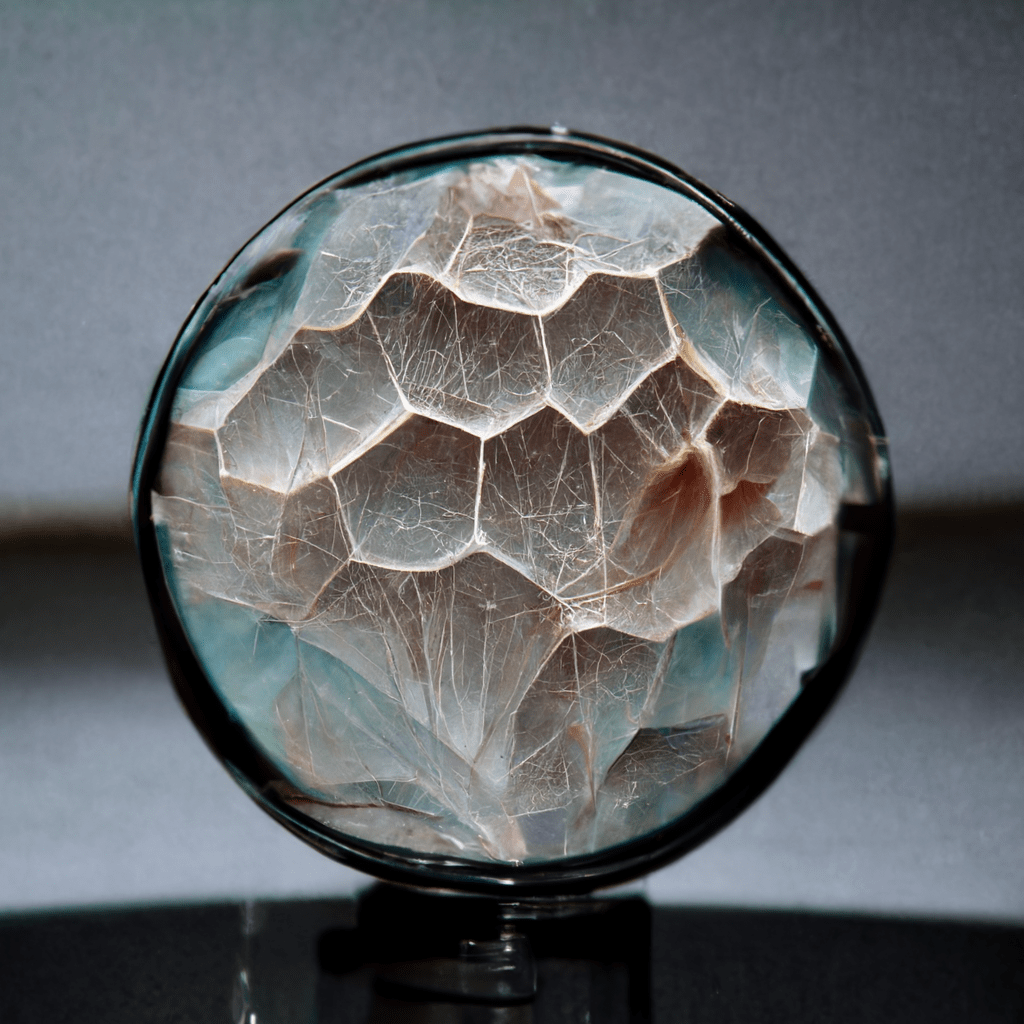
작품 <인간 물질론과 합성의 존재도>는 예측할 수 없는 일반 인공지능(AGI)의 세상, 그 거대 언어 모델(LLM)에서 필연적으로 누락될 수밖에 없는 데이터의 사례로, 동양의 명리학(命理學)을 일부 차용하였다. 서양의 분석적 사고와는 다르게 조화로움을 덕목으로 삼는 동양의 학문적 풍토로 인해 비과학적이며 미신이라 배척된, 그러나 누구나 세상에 나면 주어지는 고유 식별 데이터 생년, 월, 일, 시를 다루는 동양의 오래된 이론을 통해 세계에 존재하는 물질로서 인간에 대해 설명한다. 하늘과 땅의 관계를 보여주는 자연의 주기, 물질과 물질 사이의 감각과 에너지의 방향을 상상하며 쓴 인간 프롬프터의 시는 인공지능의 즉흥적(Impromptu), 사변적(Speculative) 상상력을 통해 시각화된다. 생성된 이미지, 합성의 존재도(存在圖)는 인간 시선이 아닌 다른 차원의 인간 초상 그리기를 위한 모델이 된다.
금나래아트홀 공연장 렉처 퍼포먼스
2024년 3월 14일 목요일 15시, 18시
2024년 3월 15일 금요일 오후 15시, 18시
금나래아트홀 공연장 스크리닝
2024년 3월 13 ~ 15일 10-19시
In the 18th century, French materialist La Mettrie applied Descartes’ mechanistic view of animals to humans and published the work “L’Homme Machine” (Man a Machine) in 1747. In the 21st century, an anonymous Artist named Sookyun Yang, inspired by the question “Is the imagination of artificial intelligence allowed?” introduces the theory of the Human Materialism.
What is the Human Materialism?
The history of Human Materialism traces back to the early stages of human civilization. Starting with the utilization of the Antikythera mechanism, an astronomical tool crafted in ancient times, and continuing with the ancient Greek philosopher Democritus, who viewed humans as conglomerates of material atoms, and Descartes, who also emphasized the material aspect of humanity. By the late 19th century, with advancements in biology and neuroscience, there was a shift towards emphasizing the physiological aspects of humans over explaining the psychological aspects. Despite some critical points, Human Materialism overall provides a framework for understanding that humans are fundamentally embedded in and influenced by the surrounding material world. It interprets humans as material beings within the vast world of matter. Existence is defined through the manifestation of material energy according to the cyclical changes of the sun, earth, and moon, utilizing a periodic table of 60 cycles derived from astronomical data recorded in the East over a long period. Utilizing this, Human Materialism attributes materiality to existence and follows the flow of its energy. While one can imagine things that do not exist, it doesn’t mean they cannot exist. Human Materialism employs artificial intelligence to construct the existence, through visual models of the theory, even for entities that do not physically exist.
** The definition of human materialism is an article created by OPEN AI’s chat GPT on April 9, 2023, and February 13, 2024, which the author modified and reorganized.
What is the Synthetic Ontography?
The synthetic Ontography is a term related to Ontology that places greater emphasis on the artistic and aesthetic aspects of generating knowledge models using purely machine-generated methods, such as large-scale language models. The Synthetic Ontography explores the possibility of creating new and expressive representations of concepts and relationships that are not constrained by traditional ontology or data sources. It enables the creation of artworks that challenge conventional ways of understanding and perceiving reality, prompting viewers to engage with the hidden meanings and emergent significances of synthesized materials. Likewise the hypothesis based on the Synthetic Ontography is not fully explored or tested, but it has the potential to impact various domains such as art, philosophy, and culture.
** The definition of the Synthetic Ontography is text generated by Bing, which Microsoft temporarily inserted into the Edge browser on January 18, 2024. It has now been changed to Copilot.
In a world of unpredictable Artificial General Intelligence (AGI), where inevitably some data are omitted in the vast Language Model (LLM), a virtual theory is created that partially incorporates Eastern metaphysical principles such as Chinese Metaphysics. This theory, based on the unique identification data of birth dates and times given to everyone upon entering the world, utilizes an ancient Eastern approach that, due to its emphasis on harmony rather than analytical thinking, has been dismissed as unscientific and superstitious in Western contexts. By deconstructing a periodic table of relationships between heaven and earth, and imagining the relationships between matter and matter, as well as the direction of energy, the human prompter uses their intuition to write poetry and utilizes the imagination of artificial intelligence for visual creation. Through the spontaneity of AI, through this speculative imagination, the prompter attempts to draw portraits not from a human perspective but from a different dimension, a depiction of existence.
Lecture Performance at Geumnarae Art Hall
March 14th to 15th, 2024, at 3:00 PM and 6:00 PM
Screening at Geumnarae Art Hall
March 13th to 15th, 2024, from 10:00 AM to 7:00 PM
 MAUM+MACHINE | SOOKYUN YANG | 양숙현